Warung Bebas
Showing posts with label Architectural. Show all posts

Thursday, February 23, 2012

Top 10 Rooftop Bars

So many rooftops, so little time to enjoy the thousands around the world that have been converted into trendy nightspots with comfy sectional seating, pools and restaurants. It seems that every major city has a rooftop bar scene, and they’re a must for any hotel claiming to be an arbiter of cool.


To narrow it all down, we've chosen the 10 best. Some are coveted A-list hangouts demanding key-card access or a VIP pass. Some are thoughtfully designed. Or they’re on the rooftops of the world’s highest buildings. Still other bars were chosen for their killer views -- and we don’t just mean of the waitresses.
Vue Bar at the Shanghai Hyatt

This two-floor bar-lounge has a wooden and brick ground floor lounge with a circular cocktail bar, DJ and reversible daybeds. Further up a spiral case on its terrace, you get unsurpassed views of the Bund (the hotel is a five-minute walk from this waterfront area in central Shanghai) and Pudong. A marble Jacuzzi is surrounded by daybeds and armchairs, and these all fill up early in the evening (including the Jacuzzi). The result is a go-to chic drinking establishment for the expat community and visiting Westerners.

Three Sixty at Hilton St. Louis at the Ballpark, St. Louis, Missouri

Cardinals diehards are given a bird’s-eye view of Busch Stadium from this bar 25 stories up, so it’s no wonder there are lineups to get into Three Sixty during baseball season. But it’s so well-designed and cozy, we predict it’ll become a year-round hangout. Fire pits are positioned strategically throughout an outdoor patio, enabling comfortable alfresco lounging in cold weather. And there’s plenty of indoor seating and flat screens for you to watch hockey on while nibbling on upscale sports-bar fare this winter.

Sky Blue at Sky Lodge, Park City, Utah 

A pool table in your hotel suite? Sky Lodge, in Park City’s historic Old Town, offers many wow moments like these, including a rooftop with views of the Wasatch Mountains. Try a Pommard, Park City’s official winter cocktail for this year, with Calvados, apple cider, lemon juice, simple syrup, cinnamon, and cardamom, as you slip into the bar’s oversize hot tub. Or tiptoe over radiant-heated floors to grab a spot by the fireplace. You’re very close to being able to shake off a hangover on the slopes. The resort has ski-in/ski-out access to Park City Mountain Resort, one of the U.S.A.'s best.

Luna Rooftop Tapas Bar, Rosewood San Miguel de Allende, Mexico

Munch on Mexican and Spanish tapas on the roof of this urban resort in a UNESCO World Heritage Site city. Luna Bar is a cozy place to observe the goings-on below on cobblestone lanes of San Miguel, north of Mexico City. And the new hotel fits right into its character-filled surroundings, featuring colonial-inspired wide stone staircases leading to airy courtyards or high-ceilinged guest suites.

Sky Yard at the Drake Hotel, Toronto

We’ll tip our hat to the Thompson Toronto’s super-trendy rooftop bar and pool, where Bay Street bankers and traders are known to book rooms for the night just to secure access to the guest-only schmooze-fest upstairs. But we like to give credit for originality, too, and the Drake Hotel, west of downtown, has an edgier, arty scene complemented by its “pop-up” rooftop bar. The theme of Sky Yard changes every few months, as do the drinks menu, décor, art installations, and music. Last fall, the bar was set up as a beer garden, featuring vintage Oktoberfest picnic seating imported from bygone German bier-fests local microbrews served by dirndl-clad hostesses.

Mikla at the Marmara Pera, Istanbul

This combination bar and fine-dining restaurant also has an outdoor pool and DJ, and it’s done in minimalist white-on-white that looks positively South Beach-y. Mikla’s vibe is mellow, with a soothing Bosphorus view and -- here’s the best part -- a sophisticated and original menu by Turkish-Finnish chef-owner Mehmet Gürs (try the monkfish, dill, lemon, and fennel risotto). This is the most exclusive rooftop in the city, but if you prefer a nightclub-y, electric atmosphere, finish your meal and head to 360° Istanbul, a famous alfresco disco-bar with live stage atop the historic Misir Apartments, where jet-setting celebrities -- from Formula 1 drivers to Paris Hilton -- keep the party going into the wee hours.

Sky Bar at Hotel Lebua, Bangkok

Sky Bar is on the 63rd floor, attached to Sirocco, one of the Thai capital’s best restaurants. And if The Ritz claims to have the world’s tallest rooftop bar, Sky Bar, 650 feet above Bangkok and its Chao Phraya River, is billed as the tallest alfresco watering hole. Order a signature Hangovertini of green tea liqueur, apple juice, sweet vermouth, and rosemary-infused honey, commemorating scenes from last summer’s The Hangover II, which were shot from the circular neon bar.

OZONE at The Ritz-Carlton, Hong Kong

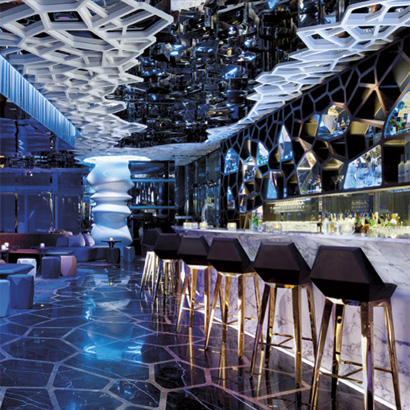
Banker and broker heaven since it opened along with The Ritz earlier this year, OZONE is the highest bar atop the world’s tallest hotel. Its lounge and outdoor terrace are on the 118th floor of the International Commerce Centre, an office-shopping complex in West Kowloon that’s packed with power brokers from Morgan Stanley, Deutsche Bank and Credit Suisse, whose Asian head offices are on lower floors. Shimmying on a neon dance floor, you’ll take in unrivaled views of the skyscraper-filled downtown.
 
Above 6 at The Thompson Hotel, New York City
 
Above 6 at 6 Columbus opened in May as the latest of Thompson Hotels’ signature rooftop bars. It has a Columbus Circle address in Midtown Manhattan, a cozy contemporary outdoor fireplace and features Blue Ribbon Sushi Bar & Grill, with a retractable roof for all-weather dining. Above 6 is open to the public by reservation, unlike Thompson's other rooftop bars, where you need to be a guest of the hotel to get in or be one of a few celebs handpicked each year to receive a “membership card.”

 Aer at the Four Seasons Mumbai
The city’s highest bar-lounge, Aer, covers the entire 34th floor rooftop of this new hotel situated in an emerging commercial district in south Mumbai. Order a champagne cocktail and chicken tikka pizza during daily half-price “sunset happy hour.” Or stay for the evening, gazing out to the Arabian Sea, while a DJ spins house and funk.

Tuesday, January 24, 2012

The 10 Best Treks In The World

These 10 classic treks are for serious walkers. All of them require a sturdy pair of lungs, fit legs and a good amount of preparation. However, if you choose to go on any of these trails then you will be rewarded with experiences that last a lifetime. In no particular order:


1. GR20, France

This demanding 15- day (168km, 104mi) slog through Corsica is legendary for the diversity of landscapes it traverses. There are forests, granite moonscapes, windswept craters, glacial lakes, torrents, peat bogs, maquis, snow-capped peaks, plains and névés (stretches of ice formed from snow). But it doesn’t come easy: the path is rocky and sometimes steep, and includes rickety bridges and slippery rock faces – all part of the fun. Created in 1972, the GR20 links Calenzana, in the Balagne, with Conca, north of Porto Vecchio.
 
2. Inca Trail, Peru

This 33km (20mi) ancient trail was laid by the Incas and is currently traversed by thousands each year. The trail leads from the Sacred Valley to Machu Picchu winding its way up and down and around the mountains, taking three high passes en route. Views of white-tipped mountains and high cloud forest combine with the magic of walking from one cliff-hugging ruin to the next – understandably making this South America’s most famous trail.
 
3. Pays Dogon, Mali

‘The land of the Dogon people’ is one of Africa’s most breathtaking regions. A trek here can last anywhere between two and 10 days, and takes in the soaring cliffs of the Bandiagara escarpment inlaid with old abandoned cliff dwellings. Dogon villages dot the cliffs and are an extraordinary highlight of the journey. The Dogon are known for their masked stilt dancers, intricately carved doors and pueblo-like dwellings built into the side of the escarpment.
 
4. Everest Base Camp, Nepal

Reaching a height of 5,545m (18,193ft) at Kala Pattar, this three-week trek is extremely popular with those who want to be able to say, ‘I’ve been to the base of the world’s highest mountain’. The difficult trek passes undeniably spectacular scenery and is trafficked by Sherpa people of the Solu Khumbu. The heights reached during this trek are literally dizzying until you acclimatise to the altitude, and the continuous cutting across valleys certainly has its ups and downs.
 
5. Indian Himalayas, India

Fewer folk trek on the Indian side of the world’s greatest mountain range. So, if isolation’s your thing try trekking in Himachal Pradesh. Hardcore hikers can try teetering along the mountain tops for 24 days from Spiti to Ladakh. This extremely remote and challenging walk follows ancient trade routes. The bleak high-altitude desert terrain inspired Rudyard Kipling to exclaim, ‘Surely the gods live here; this is no place for men’.
 
6. Overland Track, Australia

Tasmania’s prehistoriclooking wilderness is most accessible on the 80km (50mi, five- to six-day) Overland Track. Snaking its way between Cradle Mountain and Lake St Clair (Australia’s deepest natural freshwater lake), the well-defined path (boardwalked in parts) passes craggy mountains, beautiful lakes and tarns, extensive forests and moorlands. Those who want more can take numerous side walks leading to waterfalls, valleys and still more summits including Mt Ossa (1,617m, 5,305ft) – Tassie’s highest.
 
7. Routeburn Track, New Zealand

See the stunning subalpine scenery of New Zealand’s South Island surrounding this medium three-day (32km, 20mi) track. At the base of New Zealand’s Southern Alps, the track passes through two national parks: Fiordland and Mt Aspiring. Highlights include the views from Harris Saddle and atop Conical Hill – from where you can see waves breaking on the distant beach. The main challenge for this popular hike is actually securing a place among the limited numbers who are allowed on the track at any time.
 
8. The Narrows, USA

A 26km (16mi) journey through dramatic canyons carved over centuries by the Virgin River, the Narrows in Zion National Park is a hike like no other. The route is the river, with over half of the hike spent wading and sometimes swimming. The hike can be traversed in a day, though some choose to take the hanging gardens and natural springs at a more leisurely pace – spending a night at one of the park’s 12 camp grounds.
 
9. The Haute Route, France-Switzerland

Leading from Chamonix in France through the southern Valais to Zermatt in Switzerland, the Haute Route traverses some of the highest and most scenic country accessible to walkers anywhere in the Alps. The summer Haute Route walk (which takes a different course than the more famous winter skitouring route) takes around two weeks to complete. It mainly involves ‘pass hopping’ and demands a high level of fitness, with every section containing a high huff factor.
 
10. Baltoro Glacier & K2, Pakistan

This corridor of ice leads to the colossal peak of K2 (8,611m, 28,251ft), the world’s second-highest peak. This incomparable trek traverses some of the most humbling scenery on the planet. What begins following icy rivers boldly goes to the guts of the glacier before leading to the granite pyramidal mountains including Paiju (6,610m, 21,686ft), Uli Biaho (6,417m, 21,053ft), Great Trango Tower (6,286m, 20,623ft) and ultimately K2. If the 15 days doesn’t floor you, take side trips to more moraine-covered glaciers.

Wednesday, November 16, 2011

Jade Mountain St. Lucia: Where All Rooms Have Infinity Pools

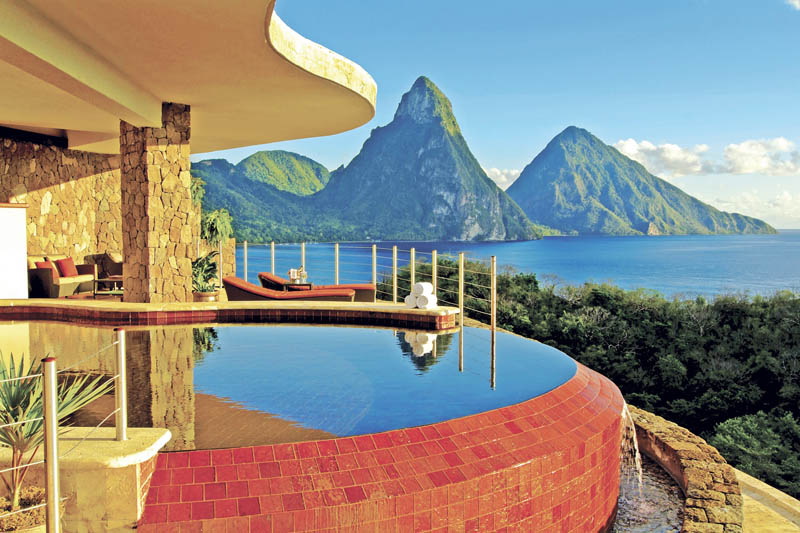
Located in the eastern Caribbean Sea, Jade Mountain in St. Lucia is one of the most incredible resorts the Sifter has seen. Each room has only three walls and a private infinity pool with stunning panoramic views of the beautiful Caribbean. A tropical oasis, this slice of heaven doesn’t come cheap, with nightly rates ranging from $950 up to $2,700 US. One can dream though!
Check out the gallery of images below along with information on the resort and rooms. Sigh…


JADE MOUNTAIN, ST. LUCIA


Rising majestically above the 600 acre beach front resort of Anse Chastanet, Jade Mountain is a cornucopia of organic architecture celebrating St Lucia’s stunning scenic beauty.
Architect owner Nick Troubetzkoy has expanded upon his philosophy of building in harmony with Caribbean nature in his creation of Jade Mountain. The bold architectural design – individual bridges leading to exceptional infinity pool sanctuaries and rugged stoned-faced columns reaching towards the sky – makes Jade Mountain one of the Caribbean’s most mesmerizing resort experiences.
Expect grand sweeping spaces where bedroom, living area and an extravagant private infinity pool glide into one another to form extraordinary platforms floating out into nature. With the fourth wall entirely absent, Jade Mountain’s sanctuaries are stage-like settings from which to embrace the full glory of St Lucia’s Pitons World Heritage Site, and of course, the eternal Caribbean Sea.
Wrapped around an infinity pool with a dazzling kaleidoscope of colors, the Jade Mountain Club caters exclusively to resident guests, celebrating James Beard Award winner, Chef Allen Susser’s “Jade Cuisine.” Hovering in space above the Jade Mountain Club is the Celestial Terrace, perfect for sunset cocktails or star-gazing.
A wide range of spa services can be enjoyed in the privacy of the Jade Mountain sanctuaries or at Kai en Ciel, Jade Mountain’s boutique spa and fitness studio.
The Jade Mountain sanctuaries are deliberately techno-free; there are no telephones, radio or television. Internet access is available at reception for those who simply cannot let go of the outside world as the resort encourages you to! The resort major domos and a dedicated resort team ensure outstanding service around the clock.
Enjoy the exclusivity and privacy of Jade Mountain with all of Anse Chastanet’s restaurants, bars, boutiques, art gallery, spa, scuba, bike and watersports facilities as well as 2 soft sand beaches available to Jade Mountain guests at all times.


DINING AT JADE MOUNTAIN


Breakfast
Breakfast is a glorious time of the day in Jade Mountain. Your choices are based on ingredients locally farmed, harvested and fished. Taking all the best St Lucian local flavor has to offer and capturing it on the plate. Freshly squeezed exotic juices, home made granola, hand picked tropical fruits, farm fresh eggs and artisan breads.
Lunch
The flavors that take shape are modern yet simple for the palate to comprehend: Crispy, refreshing salads, exciting healthy sandwiches, the best Burger in the Caribbean, and pristine fish and seafood.
Dinner
Dinner at Jade Mountain Club reflects seasonal changes of flavor with influences throughout the Caribbean. Jade cuisine is a modern fusion cuisine with cultural influences and unique techniques resulting in a wonderful taste adventure.
In Your Sanctuary
Every meal, any meal, any time! Let us not disturb you, but help you to fulfill your needs and wants in your own personal sanctuary. We cater to the mind, body, spirit and senses of our guests. The service itself always reflects a sense of warm professionalism and genuine hospitality.
The Celestial Terrace
One of the most breathtaking locations imaginable, the Celestial Terrace offers an unforgettable sunset panorama. Once night has fallen, watch the night sky and look out for shooting stars . Let the culinary team create a private dining experience for you on the Celestial Terrace.
A Spoonful of Paradise Culinary Events
Chef Allen and his culinary team have created culinary weekend events to showcase St.Lucia’s culinary heritage: Cooking In Paradise, Mango Madness, Spices of the Caribbean, Discover Chocolate
Culinary Resources
The 600 acre resort estate includes the old colonial plantation of Anse Mamin. Originally a sugarcane plantation in the 18th century, its fields were eventually turned towards cocoa bean production. The cocoa trees are still numerous on the grounds for guest to see and for us to produce our own estate chocolates. Anse Mamin is a wonderful organic resource for our menu, including turmeric, cashews, tamarind, mango, avocado, oranges, tangerines, guavas, papaya, coconut, breadfruit, yams and sweet potatoes.
Our organic farm EMERALD ESTATE in the Soufriere hills plays a major role also. From vanilla beans, bay leaf, nutmeg trees, cinnamon trees, numerous varieties of mango, sour orange and coconut trees, the Emerald farm also grows leaves, micro greens, vegetables, and herbs for the restaurant. Our close relationship with many fishermen in town as well as up and down the coast gives us access to the freshest and most pristine fish in St Lucia.

Tuesday, November 8, 2011

Tokyo's gigantic flood prevention system

The Metropolitan Area Outer Underground Discharge Channel, also known as the G-Cans Project or the "Underground Temple", is an subterranean water infrastructure project built to protect the capital Tokyo against floodwaters during rain and typhoon seasons. It is believed to be one of the largest water collection facilities in the world. 


Building began in 1992 and the massive structure now consists of five concrete silos, a large water tanks and 59 pillars connected to a number of pumps that can pump up to 200 tons of water into the Edogawa River per second. It has also become a tourist attraction, as well as a location for movies, TV shows and commercials.


The Metropolitan Area Outer Underground Discharge Channel (首都圏外郭放水路 shutoken gaikaku hōsuiro), also known as the G-Cans Project, is an underground water infrastructure project in Kasukabe, Saitama, Japan built for preventing overflow of the city's major waterways and rivers during rain and typhoon seasons.

Work on the project started in 1992; it consists of five concrete containment silos with heights of 65 m and diameters of 32 m, connected by 6.4 km of tunnels, 50 m beneath the surface, as well as a large water tank with a height of 25.4 m, with a length of 177 m, with a width of 78 m, and with 59 massive pillars connected to a number of 10 MW pumps that can pump up to 200 tons of water into the Edogawa River per second.


 Central control room

The G-Cans project is also a tourist attraction, and can be visited for free; however, as the tours are conducted in Japanese, a Japanese speaker must be present in the group to act as a translator for non-Japanese speakers.


Monday, October 10, 2011

America's Most Beautiful College Campuses

"If you ask freshmen why they chose their colleges, they usually say one of two things,” says Baltimore architect Adam Gross, who’s worked on projects at the University of Virginia and Swarthmore. “Either they got a good financial aid package or they thought the campus was beautiful."


America’s most beautiful college campuses have the power not only to sway indecisive high school students, of course, but also to attract tourists. Their appeal comes through varying combinations of awe-inspiring architecture, landscaping, and surroundings. To choose among more than 2,600 four-year American colleges, we considered these three key factors as well as architects’ expert opinions.

"The most important thing to realize is that how landscaping and buildings interconnect is as important as the buildings themselves," explains Boston-based architect Mark deShong. At Princeton University, for example, “It’s really about landscape,” he says. The campus connects its ivy-covered gray stone buildings with footpaths, idyllic small greens, and courtyards that create an intimate village-like scale.

Architectural coherence also plays a role in making a campus beautiful. Take the University of San Diego, which sticks to one architectural style: the Spanish Renaissance, with its elaborate façades, delicate ironwork, and carved wood. Ocean views and palm-tree-lined courtyards are extra selling points.

So plan your own trip to check out these campus masterpieces.

Bard College: Annandale-on-Hudson, NY

Frank Gehry’s Fisher Center—an undulating work of glass and brushed stainless steel—showcases Bard’s thriving arts scene throughout the year (current college president Leon Botstein himself is an accomplished conductor). The center is on the contemporary side of the rural campus’s architectural spectrum, which goes back to the 19th-century Blithewood Mansion and its manicured Italian garden. Pathways make for easy exploring, with the Catskill Mountains visible in the distance. —Kate Appleton

Stanford University: Palo Alto, CA

The entryway to Stanford’s 8,180-acre campus is arguably the grandest of any college campus: a mile-long, tree-lined Palm Drive, which leads up to the expansive green Oval, red-clay-roof-tiled Main Quad, and the campus’s crown architectural jewel, Memorial Church, with its striking mosaic façade.

Photo-op: The view of campus—and all the way to San Francisco on a clear day—from the Hoover Tower observation platform.

To-Do List: The Cantor Arts Center’s collection of 170 bronzes by Auguste Rodin, among the largest outside Paris, includes the Gates of Hell and Burghers of Calais. —Ratha Tep

University of Notre Dame: South Bend, IN

It’s hard to miss the glistening golden dome of the university’s Main Building, not to mention the neo-Gothic Basilica of the Sacred Heart that defines this 150-year-old Catholic school. Besides gorgeous architecture, the campus is chock-full of lush quads, where students congregate to kick back when they’re not in class — or at the football stadium. —Joshua Pramis

Florida Southern University: Lakeland, FL

What do Ellis Island and Florida Southern University have in common? They’re among the 32 U.S. spots that have recently been put under watch by the World Monument Fund as endangered cultural sites. You might also be surprised to learn that Florida Southern—on a hillside overlooking Lake Hollingsworth—has the world’s largest collection of Frank Lloyd Wright buildings, including the Annie Pfeiffer Chapel with its colored pieces of glass and wrought-iron tower. —Ratha Tep

University of Cincinnati: Cincinnati, OH

A decades-long renewal topping $1 billion is paying dividends for Cincy, which has cultivated a strikingly modern look—and proven that “it doesn’t need ivy-covered brick walls” to be beautiful, as UC Magazine put it. Notable architects Michael Graves, Charles Gwathmey, Frank Gehry, and Peter Eisenman have each made their mark on the campus, whose Main Street leads to the prow-shaped Steger Student Life Center and the Tangeman University Center, which, in 2005, dramatically repositioned the original clock tower atop a skylight in a 90-foot atrium. —Kate Appleton

University of San Diego: San Diego, CA

Some campuses are an amalgam of styles; the University of San Diego sticks to just one, and what a glorious one it has chosen—the Spanish Renaissance, with its elaborate façades, delicate ironwork, and carved woodwork. Ocean views and palm-tree-lined courtyards only add to the paradise-on-campus appeal.

Photo-op: The Immaculata Chapel, with its piercingly blue dome, visible from much of the city.

To-Do List: A walk around the Garden of the Sea, behind the Joan B. Kroc Institute for Peace & Justice, and its serene reflecting pool and gardens overlooking Mission Bay and the Pacific Ocean. —Ratha Tep

Berry College: Mount Berry, GA

This rural college holds a lofty record: it’s the world’s largest contiguous college campus in the world, with more than 26,000 acres of fields, lakes, forests, and mountains. Berry makes prime use of its setting too, with numerous reflecting pools and fountains situated nearby its beautiful English Gothic–inspired buildings like the Ford Dining Hall, Ford Auditorium, and Mary Hall, made possible by the school’s largest benefactor—Henry Ford. —Ratha Tep

Lewis & Clark College: Portland, OR

Six miles from downtown lies this 137-acre parklike campus of verdant forests, sweeping pathways, and stone walls. A tree walk with native species encountered by the two explorers for whom the college was named on their epic journey west surrounds the Frank Manor House—originally built as a 35-room private mansion.

Photo-op: The serene Reflecting Pool, bordered by a wall of wisteria, for a stellar view of Mount Hood.

To-Do List: A day hike through surrounding Tryon Creek State Park. Begin with coffee brewed with beans from Stumptown Coffee Roasters at the Lewis & Clark bookstore. —Ratha Tep

Rice University: Houston, TX

Don’t be fooled by Rice’s urban address. A double row of majestic oak trees encloses its perimeter—a harbinger of the lush 285-acre campus to come, divided into quadrangles and planted with 4,000-plus elms, hickories, maples, and other trees (a ratio of more than one for each undergrad). The oldest buildings, like the standout Lovett Hall, borrow elements of medieval southern European architecture, including grand, arched passageways and rose-hued brick. —Ratha Tep

Cornell University: Ithaca, NY

Ambitious campus planners wanted to create a main quad over dramatic Cayuga Lake, the longest of the Finger Lakes. “It’s the idea of putting education on a high platform,” says architect Mark deShong. That original plan evolved, and the beautiful setting now accommodates both historic structures (McGraw Tower) and contemporary ones like the I. M. Pei–designed Johnson Museum of Art—whose walls screen movies on summer evenings—and the new Milstein Hall by Rem Koolhaas.

Photo-op: Cascadilla Gorge, whose eight waterfalls drop more than 400 feet from Cornell’s campus to downtown Ithaca.

To-Do List: The paved paths that wind through Cornell Plantation’s 150-acre arboretum; climb to the Newman Overlook for a sweeping panoramic view. —Ratha Tep


Amazing Traveller Copyright © 2012 Fast Loading -- Powered by Blogger