Warung Bebas
Showing posts with label Adventure. Show all posts

Monday, April 2, 2012

Ha long Bay Vietnam

Ha Long Bay is in the Gulf of Tonkin and includes some 1,600 islands and islets, making spectacular seascape of limestone pillars. Because of their abrupt nature, most of the islands are uninhabited and unaffected by human presence. The great biological interest is situated in the Gulf of Tonkin.


The smaller islands are fenglin towers of 50m to 100m high. Many have vertical walls on all or most sides and these continue to evolve by rock falls and large slab failures. A distinctive feature of Ha Long Bay is the abundance of lakes within the larger limestone islands.


"Ha Long" means "Bay of Descending Dragons" (Chinese: 下龙湾; Xiàlóngwān), though prior to the 19th century this name was not recorded in any document or archive. When mentioning the present-day Quang Ninh Sea or Ha Long Bay, old historical books often referred to them by the names of An Bang, Luc Thuy or Van Don. Not until the late 19th century did the name of Ha Long Bay appear on a French Marine Map. The Hai Phong News, a French newspaper of the time, had an article, Dragon appears on Ha Long Bay, reporting the following story: In 1898 a sub-lieutenant named Lagredin, captaining the Avalanse reported seeing a huge sea snake on Ha Long Bay. This was also witnessed by many of the crews. Thus emerged the European image of the Asian dragon. Whether this appearance of a strange animal looking like a dragon resulted the name of Ha Long Bay is not known.
The Ha Long Bay archipelago is made up of 1969 islands, both settled and uninhabited. These can be accessed from various ports, though in the special case of Cat Ba you can also arrive either by car, motorbike or bus (via Haiphong) or combined bus/boat (from Hanoi via Halong City). 

Get in

There are a huge number of domestic connections, particularly to the ports of Halong City and Haiphong.
From Nanning in China's Guangxi province, the Nanning International Tourist Distribution Center (有爱南路10号(中华路口); Yǒuàinánlù shí hào (zhōnghuá lùkǒu); #10 You'ai Nanlu on the corner of Zhonghua Lu) provides daily buses to Halong City (170元, 8 hours) at 7:30AM.

By tour

There are many package tours from Hanoi, but these are best avoided and characterized by long and crowded bus rides, tourist-oriented rip-off trips on boats so slow you could swim faster (to get you to buy more food and drink on board), and other shady practices.

Get around

The islands can be accessed from various ports.

Ports

  • Haiphong, a large historic port city at the mouth of the Red River that and the fourth largest city in Vietnam
  • Halong City, spanning a portion of the northern part of the archipelago. Note that there are multiple ports within this town, in that at least one port exists that is wholly distinct from that of the tourist boat piers.
  • Cai Rong, a small port serving the north-easterly part of the archipelago.

Airports

Helicopter trips can be taken from Gia Lam Airport in Hanoi.

Islands

  • Ban Sen, a thickly forested, almost uninhabited island reachable by ferries to Quan Lan from Cai Rong.
  • Cat Ba, the home of the endangered Cat Ba langur, a national park, numerous caves and the most popular destination in Ha Long Bay for tourists. It can either accessed by local bus and ferry from Hanoi's Lương Yên bus station (recommended), by tourist boat from Halong City (a five hour 'hard sell' ordeal; this is what the hordes of Hanoi package tourists do), or by local bus or ferry from Haiphong (less scenic).
  • Quan Lạn, a historically significant outlying island with the beginnings of some tourism infrastructure and some beautiful beaches. Reachable by ferry from Cai Rong or also (reportedly) from Halong City.
  • Van Don, a large island that is well inhabited, little visited by tourists and connected by road to the mainland near Cửa Ông.


Thursday, March 8, 2012

10 Unusual Asian Delicacies

Asia is known not just for its diverse cultures and traditions, but also a galore of exotic food that often surprises and astonishes, sometimes not to a positive effect. Now to list all the unusual food found in this colorful region would be simply impossible, they are just too many. So instead, we are starting out here with a list of just ten unusual delicacies from all over the region. Know of any other delicacies that you feel should make the list? Let us know and we’ll compile them on our future update!


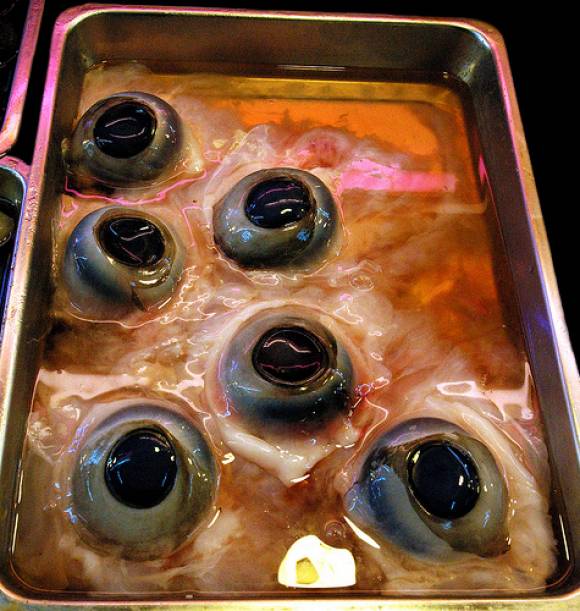
Tuna Eyes

Where to find: Japan
If you can handle your food staring back at you, feasting on tuna eyes should come as a pleasure. Except for the bizarre situation of having to look at your food in the eye, they are actually pretty tantalizing for its fatty, jelly-like tissues around the eyeballs. Some prefer to eat it raw, albeit the fishy taste, others would rather steam or fry it alongside garlic or soya sauce to spice it up. Selling for less than 100 yen (approximately US$1) in Japan, this is a popular local delicacy worth trying out!

Durians.

Where to find: Singapore, Malaysia, Thailand, Indonesia
Either you love it or hate it. This “King of Fruits” has garnered avid lovers and intense loathers alike. So powerful is its aroma (or stench), it could be detected miles away, and the smell lingers in your breath and fingers long after you are done with it. In some areas they are even banned, such is the powerful odor that comes from it! The durian has a shell full of “spikes” which you cut open and take out the fruit. They are the size of a ping pong balls, and the flesh is yellowish, sticky and gluey. Coupled with its distinctive aroma, durians come in two “flavors” – sweet and bitter. It is worth a try, or at least a sniff to experience the acquired taste of the King of Fruits.

Lamb's brains.

Where to find: India
Before anyone gags, lamb’s brains are actually pretty mild and not as revolting as you may think. They are white (when cooked, of course), tofu-like and often considered a gourmet treat prepared with Indian roti and curry. You can enjoy lamb’s brain served in various concoction – fried with tomatoes, egg, masala or even plain.

White Ants Eggs Soup.

Where to find: Thailand, Cambodia, Vietnam
Walk along the streets of Sukhumvit, Bangkok and you’ll discover a whole new diversity of Thai gourmet. From restaurants to street stalls, the myriad of food will leave you bedazzled. But from delight to shock comes street stalls offering delicacies such as scorpions, beetles, grasshoppers, frogs, usually fried. White ant (or termites) eggs soup are probably one of the weirdest choice out of the rest, but they taste surprisingly good! The soup comes with a mixture of eggs, half embryos and baby ants. The eggs are soft and pop gently in your mouth with a wee bit of sour taste.
Smelly tofu.

Where to find: Hong Kong, Taiwan, China
As the name suggests, this popular street snack is renowned for its pungent smell, often likened to garbage or manure. The smelly toufu is actually fermented tofu, best eaten with sweet or spicy sauces. Despite a smell that turns most people away, even for its enthusiasts, smelly toufu has a light taste and once it tickles your fancy, you could be a fan of it.

Balut.

Where to find: Phillipines
Native to Phillipines, Baluts are half-fertilized duck or chicken eggs boiled with its shell. It doesn’t exactly look inviting as the semi-developed ducklings are already visibly formed. However, the Balut is a popular local dish eaten throughout the Phillipines, believed to be an aphrodisiac and considered a high-protein, hearty snack. Often served with beer, the biggest challenge in trying out balut is overcoming its unappetizing sight, but most people would agree that it tasted much better than it looks.
Fugu (Blowfish)

Where to find: Japan
This rare delicacy in Japan is only for risk-takers. Intensely dangerous due to its high tetrodotoxin content, which can thwart the nervous systems in minutes and kill in a few hours, this dish is served strictly in licensed restaurants. Like an art, the fugu is delicately prepared through various complicated procedures to ensure that the toxins are thoroughly cleared. It is thinly sliced and often served as sashimi (raw). Dip the meat with wasabi or Japanese soya sauce and pop it gently into your mouth. Some professional chefs prepare this delicate sashimi so there is a minute amount of poison in the meat, giving a prickling feeling and numbness on the tongue and the lips. Fugu is considered a luxury good in Japan, costing up to USD$200 for a full set.

Drunken Shrimp.

Where to find: Shanghai
When I first heard about the dish Drunken Shrimp, my first thought goes to the usual style of steaming your shrimps in a healthy dose of wine and alcohol. It gives the shrimp an additional dash of sweetness, making it a favorite of mine. The actual Shanghainese Drunken Shrimp however, is an entirely different experience – most notably because of the absence of steaming, or any kinds of cooking whatsoever. The shrimps are not only raw, but live! They are served bathed in strong liquor, which helps to make the shrimps less feisty, and you eat the still twitching body right away after you decapitate the poor fellow.

Beondegi (Silkworm Larvae)

Where to find: South Korea
Literally meaning “chrysalis” or “pupa” in Korean, the Silkworm Larvae are a popular snack in South Korea. They are either steamed or boiled, and then seasoned before serving. If you can get through the subtle, nutty aroma, these little guys are crunchy with a unique, strange texture inside.

Tarantula snacks.

Where to find: Skuon, Cambodia
During the years of terror under the Khmer Rogue, starvation was rife across Cambodia, and the people began eating anything they could get their hands on. The tarantula was one such subject, and the people of Skuon, Cambodia, developed a taste for them, even long after the regime change. These distant cousins of the crab are crispy on the outside and gooey in the middle, with the white delicate meat in the head and body tasting rather like a cross between chicken and cod.

Monday, March 5, 2012

Top 5 Must Do Adventures in Malaysia

The South East Asian country of Malaysia is a mix of two halves, separated by the South China Sea. The peninsula boasts the modern city of Kuala Lumpur, with its sprawling suburbs and adjacent towns, while the Borneo is renowned for their breathtaking, untamed landscapes, wildlife, spectacular diving sites and diverse cultural heritage.
 

From timeless tropical rain-forest and national parks to rugged mountain terrains, there is much to explore and experience in this melting pot of world’s cultures. Here are the top 5 Malaysian adventures for nature and adrenaline lovers alike.


1. Live with the Penan tribe


The Penans are an ethnic group of Borneo. Out of the 10,000 Penans, it is estimated that only 200 are still living their traditional nomadic hunter-gatherer existence in Malaysian state of Sarawak, Borneo.
In the Penan language there are forty words for sago palm, and no words for goodbye, or thank you – or thief. The Penan view the entire rainforest as their home. One that is under severe threat as commercial logging continues to destroy the forest around them.
Groups of up to forty move around a landscape of steep valleys and dense dipterocarp forest interlaced with numerous tributaries of the large rivers draining the islands interior to find stands of the wild sago palm.
   What is this adventure?
  • Explore one of the few remaining unprotected areas in Sarawak that has not been logged.
  • Live with and learn about Borneo’s most fascinating, secretive and least understood tribe.
  • Getting off the tourist track and be integrated into the tribal life.
  • Opportunity to appreciate mountains, caves,waterfalls, lakes, forests and wildlife upclose and personal.
  • Experience the traditional culture of blow-pipe making, rattan weaving, storytelling, wildlife tracking, medicinal plants and ethno biology.


2. Mulu Adventures – hear the call of the wild!


Mulu is Malaysia’s adventure capital. Challenging jungle hikes, magnificent World Heritage caves, the ‘Pinnacles’, home stays in longhouses with native tribes – all set in the prettiest of tropical jungle landscape. Choose to mountain-bike to Mulu, swim or raft the rivers, climb the ‘Pinnacles’ or Mount Mulu, hike the once feared ‘Head hunter’s trail’, burrow deeply in adventure caves, search out wildlife or choose to do it all at a leisurely pace.
    Main attractions around Mulu:
  • Deer cave – the single largest cave passage known to man and home to millions of free tailed naked bats
  • Clearwater cave – named after an underground river system that flows through the cave systems and culminates with high velocity through this chamber. This is the longest known underground river in South East Asia.
  • Lang’s cave – containing gorgeous formations that adorn the walls
  • Wind cave – named after its natural air conditioning and containing colourfully named chambers such as King’s and Lady’s chamber.
  • Sarawak Chamber – the world’s largest discovered underground cavity located in Gua Nasib Bagus. The chamber measures approximately 700m long, 415m wide and 80m high. In width, you could almost fit 7 units Boeing 747′s from wing to wing. In length, almost 10 units! It takes almost a full day to reach Sarawak Chamber and requires a certain fitness level. It is in the adventure-caving category.
  • ‘The Pinnacles’ – a series of limestone razors that mystically jut out half way up Mount Api. The trail is only 2.4kms but the ascension is 1200m up a steep path to a viewpoint looking out over the Pinnacles. This is Malaysia’s 5 star hike!


3. Climb Mount Murud , the highest sandstone mountain in Sarawak


The Kelabit highlands is one of Sarawak’s last unspoiled regions with beautiful flora and a cool refreshing climate. The vegetation changes as you ascend and along the way, you witness local life with plenty of opportunities to interact with the friendly natives, mainly Lun Bawang and Kelabit tribes.
The first person to have successfully climbed to the summit of Mount Murud is a Swedish Zoologist and Ethnographer, Eric Mjöherg, in 1922.  Mjöherg was astounded by the many species of plants found there, especially pitcher plants that are endemic to this location. He documented many of plants and flowers, describing the mountain as a paradise which will forever be embedded in his mind.
Many locals regard Mount Murud as a sacred location. Rumors of many astounding miracles is said to have happened here. Local folks make an annual pilgrimage to celebrate its majesty, therefore, it is no surprise that you will find a large church camp made of many assembled wooden houses on a plateau which can accommodate 1500 people.


4. Climb the World’s Highest Via Feratta on Mount Kinabalu


I was the third person to have climbed via feratta when they first opened in 4th quarter of 2007. I can definitely pledge to its WOW factor.
Battling the early morning chill, initial fear of the heights and mild altitude discomfort, the activities offered are not for the weak-hearted.
If you are afraid of heights then this adventure may not be for you as you will be walking on vertical surfaces as well as crossing valleys on cable lines. Although you will be led by an experienced guide, each participant will have the responsibility to look after each other as you are all linked together by a rope.
Besides a helmet and training before the activity, you will be assured double safety on the climb. A climber wears a harness clipped to a steel cable along the route and a second line is clipped to the next climber or the guide. The steel cables that line the route can hold up to 3,000kg of weight. The ladder rungs and footholds are rated to withstand up to 300kg of weight. The routes have been set up by the best via feratta builders from Europe and its no wonder that MT has been awarded a certificate of compliance based on European safety standards for Via Feratta. I’ll let the photos speak for themselves!


5. Accelerated Freefall


The Accelerated Free Fall (AFF) course is a private instructor-assisted learning process which teaches you to become a licensed skydiver. Its progression is several times faster than the traditional static line program and has now become very popular for individuals who want to reach the level of a licensed skydiver faster and with proper instruction from a USPA licensed instructor/s.
During freefall, skydivers generally do not experience a "falling" sensation because the resistance of the air to their body at speeds above 50 mph (80 km/h) provides a sense of weight and direction. So you are not exactly weightless, contrary to popular belief! And it gets better. Skydivers reach terminal velocity around 190 km per hour and no longer accelerate towards the ground. At this point the sensation is one of a hard wind!

Friday, February 10, 2012

Travel to India - Advice and tips for first time travellers

There's no denying that travelling to India can be a major culture shock, especially on your first visit. It's a huge and bewildering country, with many different religions and cultures, and cities that roar with traffic and bustle with activity non-stop. So how to prepare for this assault on the senses? We reckon that if you want to get the most out of your trip it's best to:


Avoid burnout

By far the most common complaint reported by first-time visitors to India is fatigue - simply trying to do too much in too little time. India is vast, colourful and addictive, but have realistic expectations about how much you can see. A wisely planned visit to a particular area can deliver far more of the unique texture and spirit of the place. And remember, India isn't going anywhere - you can return time and time again.

Get out of the city


Though perhaps a cliché, the only way to get a true sense of India is to visit smaller villages. The real benefit is that it'll get you out of the sprawling and vastly overpopulated cities. Once you've cleared your head, say with a trip to the mountains or into the slower-moving land of Kerala in the south, you'll be far better placed to enjoy the famous hospitality of the Indian urbanites.

Watch what you eat and drink

A dodgy stomach is pretty common for first-timers in India. That doesn't mean you should rule out street food, but try to stick to peeled fresh fruit and foods that have been either boiled or fried. Stay on the bottled water and avoid salads or ice.

Don't be too precious about your personal space

This isn't really a popular concept in India. You will be squished on public transport and squashed in lifts. People will ask seemingly intrusive personal questions that you may find intimidating. Remember that this is a wholly different culture and the questions are merely indicative of the locals' polite interest in you.

Dress conservatively


Be aware that India has a relatively modest culture. Covering arms and legs is a simple step toward respecting this. Indians are forgiving of those who aren't familiar with their culture, but you can quickly make a good impression by, for instance, removing your shoes before entering someone's home. This is particularly important when entering a sacred space, like a temple. Also, if you see shoes outside a shop, it's a sign to remove your own.

Watch those feet and hands

Feet are considered to be unclean in India, so if you touch something with your feet it's appropriate to swiftly apologize. Similarly, eating or passing objects with your left hand is considered unpleasant for reasons best left to the imagination. If unsure of local customs, keep an eye out for what others do and imitate.

Remember that Indian time is relative

You may well find yourself waiting half an hour in India when your friend has assured you they will be five minutes. Traffic and other interruptions can also mean that getting around can take a lot longer than expected. Build in plenty of room for unexpected waits and make sure to check opening hours - many government offices and shops close in the afternoon for lunch.

Stay safe

While "don't go down dark streets alone" might seem a bit obvious, there are plenty of straightforward ways to avoid subtle dangers in India. Carrying huge quantities of cash isn't a good idea anywhere, but in crowded Indian cities pickpocketing is a very present problem. Equally, haggling at a market can, at times, become an unpleasant, heated exchange. Inexperienced visitors are advised to try to stay cool. Be pleasant but firm, and don't allow yourself to be irritated.

Be prepared for noise


One way of ensuring you can have a bit of personal space, albeit in your head, is to have earphones with you to shut out some of the surrounding din - there's nothing like the sheer clamour of an Indian city.

Avoid deals that seem too good to be true

Government shops are probably the easiest way to avoid running foul of scams, but simple rules like paying for things with cash, to avoid card cloning scams, may save you a lot of unnecessary trouble later in your journey. You should also pay particular attention if you're arranging to have things sent home by post, as it's not unknown for shops to take your payment and send worthless items instead.

Adventurous Destinations for Solo Travelers

As an occasional solo traveler, picking the right destination to explore is not quite as easy as one would imagine. Since our move to Spain, Alberto has settled into his new job so that leaves me and my backpack, out to see the world alone. As much as I enjoy the prospects of meeting more people and having the freedom to do whatever I want, solo travel can be a little daunting at times.

Especially for a solo female traveler, it’s wise not to be wary of your surroundings. In this post, I share with you some of my suggestions for the best adventurous destinations for solo travelers.

1. Australia


For the ultimate adventurous holidays, Australia definitely wouldn’t disappoint. Few places in the world can beat Australia’s myriad of natural spots and adventurous activities – scuba dive the Great Barrier Reef, then skydive in Sydney, and go bush-walking in the outback – Kakadu National Park. Besides world-class infrastructure and some of the friendliest people in the world, Austalia makes for a safe and easy destination for solo travelers.

2. Tanzania


Although African capitals can be slightly intimidating, venture out to the savannahs and wild lands and you’ll find the warmest people who are more curious about you than anything else. This East African nation is bursting with thrilling outdoors opportunities ideal for the solo traveler. Sign yourself up for an adventure tour – from the Kilimanjaro trek to a wildlife safari or scuba-diving trip on Zanzibar island – you’re sure to meet fellow travelers and have a wild time. Unlike the usual stereotype view, Tanzania is relatively safe to travel alone, just try to avoid dodgy areas in the capital city.

3. Malaysia


Being a Muslim country, Malaysia is often misunderstood by many as conservative and unwelcoming. But adventure travelers who have given it a shot all leave with a big smile – Malaysia is packed to the brim with raw, unexplored natural spots and bewitchingly beautiful terrain. Explore its acres of dense rainforest and mingle with orang utans or live with ancient tribes, then emerge out of the forest to find clear, turquoise waters, home to some of the world’s best dive sites. And its people – you can hardly find such genuine and hospitable people elsewhere.

4. Ecuador


A small nation chocked full of rare and endemic wildlife and nature, Ecuador is a country only worthy of superlative descriptions. With natural wonders that hit the right sensory glands, you can feed your craving for all things natural here in one small country. Swim with sea lions, sharks and penguins on the Galapagos Islands, hike through the culturally-rich Amazon Rainforest or climb the Cotopaxi Mountain – you could easily do all that in one week. What’s more, Ecuador is one of the better-off countries in South America, equipped with better tourism infrastructure than its neighboring nations.

5. Jordan


Amongst the Arabic nations, Jordan is tops on my list – especially in terms of ease of travel, security and sights to see. Float in the Dead Sea in the north and then head down south to explore the archaeological sites of Petra and then hop on a camel safari through Wadi Rum desert. Unlike neighboring Egypt or Israel, the country is not overrun with tourism and dominated by foreigners. To see a real peek into the Middle Eastern world, Jordan would be a great start.

6. Macedonia


During my recent solo jaunt in the Balkans, Macedonia definitely left a deep impression on me: Not only were the locals helpful and forthcoming, the country is also shaped perfectly for intrepid adventure travelers looking to get off the beaten path. Composing of a multitude of mountains and emerald lakes, Macedonia is favored by outdoor lovers who enjoy hiking, climbing and boating. Be sure to check out Lake Ohrid and the Bitola Mountains.

Wednesday, February 1, 2012

A Trip Through Peru

Exploring the wilds of the Amazon, the high-altitude waters of Titicaca, and the mysteries of Machu Picchu, Dreaming Traveller revels in the sheer, exuberant abundance of Peru.


South America has been around no longer than North America, and yet there seems to be more history in Peru: more pre-Columbian history and more colonial history and quite a lot of recent history. There are more birds in Peru, and they have more colors in their bright wings. More foods come originally from Peru—including both potatoes and tomatoes—than from any comparable square mileage anywhere else. There are more languages spoken in Peru, even if some are spoken by very few people. There are more climates there, packed in tight next to one another, most of the world’s ecosystems in narrow-wale stripes. When it rains, there is more rain; and when the sun is overhead, there is much, much more sun, and you need much more sunblock to survive it. The rivers are bigger and wider and faster, the earthquakes stronger. Peru has the Americas’ deepest canyon and the world’s driest desert. There is more luxury than you might have expected, even if there is also more privation than you might have hoped. There are definitely more holidays in Peru, because there is more faith in Peru, and from the darker wilds of the country on moonless nights, there seem to be more stars in the sky. It can get a little tiring, this maximalism; you wish from time to time that there were not so many waterfalls and inexplicable stone walls, but it cannot be denied that when you think of home from Peru, home seems pallid.


My partner and I began our trip with a week on the Amazon, which officially originates in northern Peru at the confluence of the Ucayali and Marañón rivers. The Amazon Basin has a dry and a rainy season, but it rains almost as much in one as in the other. It is more useful to think of them as the flooded and low-water seasons, for melting Andean snow and highland rains engorge the river between November and June, when it ignores its moderate winter banks and spills into the jungle that was previously its border, rising by as much as 40 feet. Geological time speeds up here. You can see riverine erosion and accretion as if you were watching a stop-motion film. We saw an entire grove of bamboo mudslide into the water, and, later, a snarl of the plants catch firmly on the opposite bank. The river’s water is brown with churned earth, and great messes of wood and broken things rush past you as if they were late for a party in Rio.
The canopy of the rain forest is more accessible when the river is flooded; indeed, you can float within reach of last month’s distant treetops. High-nesting birds are closer, though the soaked ground hampers walking. There are few large mammals, and the vegetation is so thick that one seldom sees them. Even our guides, jungle-born and -bred, had rarely spotted an ocelot, or a jaguar, or the world’s largest rodent, the two-foot-tall capybara. You visit the Amazon to see birds, monkeys, the pink river dolphins, and the much-maligned piranhas, and to bask in a seemingly limitless ecosystem. There are tiny villages and ranger stations here and there, and every so often a banana boat passes by on the main river, but essentially you are away from human habitat. There are no satisfactory maps of the Peruvian Amazon because it is in a state of permanent flux; it wriggles around like an insomniac, flinging itself this way and that way, rolling back to where it was in the first place, carving estuaries into yesterday’s land.


Our sleek, modern 130-foot boat, the Aqua, has set out to bring luxury to one of the earth’s most daunting wildernesses. When we caught sight of it from our excursionary skiffs, it looked as out of place against the torn shores of the tempestuous waterway as Fitzcarraldo’s boat pulled up a mountain. Sometimes, conversely, we would lie on beautiful pillows and gaze out huge plate-glass windows, and the torrid water and dense jungle seemed like multimedia projections because they were so incongruous with our urbane suite.
The Aqua was conceived of and built by Francesco Galli Zugaro, a dashing 36-year-old who rides on the boat for a few days each month. It is the love project of his fertile imagination, and his exuberant aura of discovery seems woven into its very fabric. He has had to contend with a turbulent debut: not long after our trip, the Aqua was twice attacked by armed bandits, who made off with guests’ valuables. No one was hurt, fortunately, and security has since been dramatically increased, provided by the Peruvian Navy and the national police.
The Aqua was designed and decorated by the noted Peruvian architect Jordi Puig with the spare, elegant coolness of Richard Meier: wall panels of soft white lighting, bathrooms with the latest eco-sensitive technology, Brazilian slate walls, floors of handsome local wood, California king–size beds, and those astonishing outer walls of glass. It’s as if 12 rooms from the W Hotel had decided to run away to sea together. The boat holds 26 passengers and 21 crew members, so the feeling is intimate. The menus were devised by Pedro Miguel Schiaffino of Malabar, one of Lima’s leading chefs, to meld jungle flavors and classic dishes: a soufflé made of fresh hearts of palm; broth of armored catfish with wild cilantro; a warm passion-fruit tart that sang in the mouth.

It is a truism of cruises that staff tend to be jolly, but it is in general a rather forced jolliness. On this trip, the staff seemed genuinely to be having a good time. They worked like the dickens: a team of trained naturalists who could whistle the call of any bird or primate, seducing them into view as surely as the Pied Piper, or spot a camouflaged toad at night as we careened by in the skiff; a bartender who could make a mean camu-camu-infused pisco sour. When we returned to the boat at the end of an occasional night tour, going in our dark skiffs around a bend in the dim river, the miracle of the Aqua struck us again: it looked like some river-bound constellation recently fallen from the night sky.

We explored the black water, the stiller areas, rich in tannins, which reflect everything as in a glass, darkly. On one particularly memorable day, we took the skiff for almost five hours until we found a lagoon so dense with floating water lettuce and water lilies that it covered the entire surface, and we motored slowly through what appeared to be a field, an impression made stronger by the long-legged jacana birds that skittered across the unmoored plants. The green parted for, then closed behind, us; earth was water, and water, earth. In a tree at the end of this green wonderland we found a three-toed sloth, perhaps nature’s weirdest creation, E.T. draped in a moth-eaten fur coat. The name “sloth” suggests laziness, but a sloth’s slowness is more like that of a smack addict. They hang from branches, turning their heads as if tomorrow might lie in any direction, occasionally munching on the hallucinogenic leaves of the cecropia tree. That night, we went to see nocturnal creatures, and I expressed regret that it was impossible to photograph the spectacled caiman, a carnivorous reptile closely related to the crocodile. Minutes later, while the captain held his legs, our valiant guide, Víctor Coelhos, cantilevered himself off the front of the skiff, plunged his arms into the muddy waters, and lifted a squirming juvenile into the air, holding it in such a way that we could photograph it and it could not remove his fingers.
If you go to the rain forest during the rainy season, chances are you will encounter rain. We did, but it was usually brief, sometimes giving way to clear skies and more frequently to clouds that softened the heat. On our penultimate day, we came through a dense patch of water hyacinths and found ourselves looking head-on at a rainbow, and as we drew in our breath, a flock of perhaps 40 green parrots skittered across our path. Pink is the navy blue of Amazonia: there were not only the pink river dolphins we loved, but also the pink-toed tarantulas and cascades of pink morning glories, more delicate than bougainvillea, a confetti dangled over the black water. In a week, we had traveled 500 miles, from Iquitos to the Pacaya River and back, and seen more than 80 species of birds, two dozen kinds of mammals, and an eccentric array of fish and reptiles. I had draped an anaconda around my neck, and then a boa constrictor; we had fished for piranhas with stick-poles. We had been received in one village by dancers and musicians, and in another by the old men who repaired the nets and broke the husks off rice. We had learned the names and cries of the prehistorically plumed hoatzins (pronounced “watseens”), the red howler monkeys, and the horned screamers with daft feather-like tufts on their foreheads. We had seen parrots and macaws, toucans of every shape and size, and, once, an anteater up in a tree. We had learned (but did not exercise this knowledge) that you can scoop up termites and rub them between your hands to make a natural mosquito repellent. We had seen dragonflies with red heads like matchsticks, and blue morpho butterflies, cerulean as the eyes of a fairy-tale princess. Everywhere we found water hyacinths in bloom; Monet’s lily pond had nothing on these streams. At night, in perfect isolation, we had gaped at a sky overcrowded with jostling stars and striped with the Milky Way.

If the miraculous universe of Amazonian Peru can be credited largely to the absence of human incursion, the thrilling destinations along the western slopes of the Andes owe as much to civilization as to nature. Monumental stone terraces climb like sinuous staircases toward the hilltops, giving testimony to the Inca genius for maximizing agricultural yield despite heavy runoff and poor soil. The colonial Spaniards who decimated the Inca empire robbed the natives’ precision-hewn stones for their own churches, whose hopeful spires punctuate the skyline in towns great and small. To enter this other world, you need guidance, not because it is dangerous, but because the muchness of it requires canny sorting. We ventured out under the aegis of Marisol Mosquera and Aracari Travel Consulting, which employs a network of extremely knowledgeable local guides. Mosquera brings not only elegance and panache to her work but also wisdom and a sense of history; she keeps you comfortable but helps you penetrate to the truest Peru, to experiences you might not otherwise have accrued until you’d visited the country 40 times. Her company restricts its purview to Peru, Bolivia, and Ecuador, including the Galápagos, and you are not put at a hotel or recommended a restaurant that she has not personally checked out. In 20 years of writing about travel, I have never enjoyed such impeccable personal attention.
Fresh from the Amazon and a night in Lima, we headed off to the Sacred Valley of the Urubamba River, where Inca ruins and terraces are scattered as densely as Starbucks in Manhattan. We started at Pisac, whose serpentine terraces echo the undulating slopes. The nearby town’s Sunday market is given over half to the touristic takeaways that hardly vary from place to place—the Indigenous Mall—and half to a bustling food emporium where sturdy women in serapes and bowler hats hawk every color and size of potato and corn kernels as big as the Hope Diamond. We lunched there, then headed for our siesta, and Susy Dyson. Dyson, a Peruvian of English descent, became Peru’s first supermodel 30 years ago in Paris, had a career as an actress and singer, and then quit the jet set to move home to Lima and have a family. Two years ago she bought a tract of land on an Inca terrace near Urubamba and transformed it into an inn, Ticllabamba. It has just three suites, set amid lush orchards and countless vistas; completely designed by Dyson, the place is simple and understated. Altitude is exhausting and we were tired, so Dyson arranged for the chef-owner of one of Peru’s top restaurants, Pio Vásquez de Velasco of nearby Restaurante El Huacatay, to come over and give us a cooking lesson, then make an indescribably delicious dinner that included a carpaccio of alpaca marinated with thyme and served with dried tomatoes and pecans. The feeling is more like visiting a marvelous friend in her charming compound than staying in a hotel.
One of the things there is more of in Peru is ruins, some of them hardly ruined. We had seen dozens of sites by the time we made our way to Machu Picchu with jaded eyes, taking the opulent Hiram Bingham train to arrive at the Machu Picchu Sanctuary Lodge. Then we walked to the site, and looked at the face of its splendid mystery. While not as extensive as Angkor Wat or as refined as the Taj Mahal, it has in common with those world monuments the quality of being utterly surprising, no matter how many images of it you have seen. It is partly that it is so ambitious and partly that it is so exquisitely situated, spilling along ridges and across hillocks and down vertiginous drops, taking in the surrounding peaks hundreds of feet above and the rushing river hundreds of feet below. Walking these streets, you feel that there was tremendous intention in this construction, though it is impossible to know just what was intended.
Cuzco is one of those cities, like Venice or Bruges or Suzhou, that is so exquisite that everything else about it seems irrelevant, and no glut of tourism can quite cancel its charm. The Plaza de Armas is one of the world’s great squares, with its two splendid colonial churches, including the cathedral, known for a painting of the Last Supper that shows Christ and the apostles dining on guinea pig. The Inca sites around the edges of town are spectacular, especially the intimidating stone ramparts of Sacsayhuaman. In mixing native and Spanish culture, Peru arrived at a style that seems like Europe viewed through a bright kaleidoscope. Cuzco has fine hotels, and we stayed at La Casona. Our room had carved doors, framed Incan textiles on the walls, antique furniture, dark-wood shutters that opened to a beautiful view of the square, and a colossal bathroom of striated marble. The 16th-century building consists of just 11 rooms around a cloister court. Down the road is the superhip, Italian-designed Casa Cartagena, also installed in a great historic house.


Driving the 240 miles of high country southeast from Cuzco to Puno, we went through a succession of villages defined by what they make: the village of fried pork skin (chicharrones); the village of roasted guinea pig (cuy); the village of bread; the village of textiles. Then we came at last to the Church of San Pedro Apóstol de Andahuaylillas, sometimes called the Sistine Chapel of the Americas, which the World Monuments Fund is helping to restore. It looks like a pleasant village church, but the doors open to reveal an interior that is relentlessly decorated, covered in frescoes, with a ceiling of a thousand medallions and an altar all silvered and gilded and mirrored, rather churrigueresque, and ingeniously harmonious. Fifty miles farther, we got to Raqchi, site of a 15th-century Inca town made mostly of mud bricks, yet of phenomenal size, the towering columns of its Wiracocha temple built to support what is believed to have been the biggest roof in pre-Columbian America. We drove on into the Altiplano, the high plains with elevations of more than 12,000 feet—great, flat stretches set in the jagged humps of the Andes, like the boundless footprints of a forgotten giant.
Puno is something of a dustheap, but from it you can explore the beauty of Titicaca, the world’s highest navigable lake. We went by boat first to the Uros Islands, floating man-made blocks of totora reeds, continually replenished with new layers on top as the bottom layers rot in the water, each island moored to an anchor. When the Uros leave their reed houses on their reed islands, they go in boats made of reeds, many with elaborate reed figureheads of pumas. Each island has a watchtower from which signals may be sent to neighboring islands in case of trouble, and that too is made of reeds, though it has wooden legs. The staple of the Uros diet is the starchy, white heart of the reeds. This universe of reeds is exquisite through monoculture; there is something meditative and transfixing about a place where the only points of difference are the water, the sky, and the brightly colored clothing of the people.
On Taquile Island, another 2 1/2 hours away, all the women weave, and all the men knit. The women weave long belts, and the men knit hats on needles as fine as pins. The handiwork is just extraordinary, and one only wishes one could commission something other than a woven belt or a knitted hat. Peru is rather rich in knitted hats, and there are only so many of them that anyone can incorporate into his daily life, and these particular woven belts are hard to carry off if you are not specifically trying to look like a traditionally dressed woman from Taquile.
In mid-afternoon we arrived at Suasi Lodge, set on the only private island in the lake, within view of Bolivia. The eco-lodge, now run by Casa Andina, was founded by Peruvian sociologist Martha Giraldo as a nature reserve. It is a place for the sort of calm reflection that befitted our last full day on such a full vacation. So much of Peru is a fiesta of stimulus. After a couple of weeks of that, Suasi is an oasis.
We left Peru by way of Lima, where we had dinner with Mosquera at Rafael Restaurant, which is one of Lima’s best. As befits the land of more, there are more than 3,000 kinds of potato grown in Peru, and in the course of our trip we had many that were unlike anything I ever had before, including wild jungle potatoes. There are over 2,000 kinds of fish in the waters of Peru because a deep Arctic current upwells off the coast, creating some of the most plankton-rich waters in the world. There are huge numbers of novel fruits and vegetables; we became obsessed with lucuma, a fruit that tastes like a cross between dates and butterscotch, at its best in a traditional Lima dessert called suspiro a la limeña.
Any good trip is orchestrated, and this one had been written by Mosquera in distinct movements. We had started low and made a gradual ascent, the better to avoid altitude sickness, but the trip was also modulated in its harmonic shifts from the wild exuberance of the Amazon to the mystery of the Sacred Valley to the stupefaction of Machu Picchu to the elegance of Cuzco to the breathtaking austerity of Lake Titicaca. This is a country where more is definitively more.

Thursday, January 26, 2012

Puerto Morelos - Maxico

Puerto Morelos is a town in Quintana Roo on the Yucatan Peninsula, about 20km south of Cancun. It is both a fishing village and a resort and diving destination. It is located roughly halfway between Cancun and Playa del Carmen on the Caribbean coast of Mexico's Yucatán Peninsula. 


The pier in the center of town hosts snorkel and sport fishing boats while yachts dock in a man-made harbour just south of town. The village used to be the embarkation point for the car ferry to Cozumel, but that now leaves from Calica, a major port south of Playa del Carmen. 


About

If you’re looking to escape the crowds of the Riviera Maya, don’t miss Puerto Morelos, just 20 minutes south of Cancún.

It's the ideal location for those who want a quiet beach vacation away from the glitz, but with ample tourist amenities. The town has just two principal streets and you can walk from one end to the other in about 15 minutes.

You can get by with English, but Spanish is not superfluous. Most places accept US dollars but not credit cards. Almost all prices are quoted in Mexican pesos and it is generally cheaper to pay in pesos, than in US dollars.

The reef just off shore is part of the Great Mesoamerican Reef, the second largest reef system in the world and the largest in the Western Hemisphere. In 1998 the reef in front of Puerto Morelos became a protected National Marine Park, preserving its rich biodiversity and making this area one of the best preserved of the Great Mesoamerican Reef. Buildings in Puerto Morelos are limited to three stories by local bylaws, to preserve the village type of character.

There are two parts to Puerto Morelos, the former fishing village on the coast, now Hotels, Condominiums, Restaurants and Tourist shops, and the second part about 2 Km. inland and adjacent to Highway 307, on the western side, called La Colonia by locals. The inland portion is mainly single level dwellings for the local workers, as well as amenities such as small/local food stores, pharmacies, and several casual restaurants, serving simple fare such as tacos. 
 
 Beach at Puerto Morelos, in front of the Casita del Mar at the north end of town

Get there

By plane

The nearest major airport is in Cancún International Airport (IATA: CUN) (ICAO: MMUN). It is 20km away from Puerto Morelos and is Mexico's second busiest airport.

By car

Puerto Morelos is situated at the junction of Route 307 and a paved road to Leona Vicario in the interior of the Yucatan Peninsula. This recently paved road is the eastern terminus of La Ruta de los Cenotes, a network of minor roads that allows access to many cenotes in the interior. At Puerto Morelos, the beginning of this road network is marked by an archway. The waterfront is about 2km from Highway 307. Puerto Morelos is about 30km south of Cancun, 30km north of Playa del Carmen, and one hour north of Tulum.

By bus

Buses from Cancun and Playa del Carmen traverse Route 307, the coastal highway and the main highway into town:
  • From Cancun airport take the Riviera/ADO bus to Playa del Carmen, hourly from 10:30. The bus departs from Terminal 2, east end (terminal faces north). Buy a ticket for Puerto Morelos just inside terminal or on bus. Ask the driver to stop at Puerto Morelos. Cost: 50 pesos as of 12/09
  • From downtown Cancun (el centro) take the Riviera/ADO bus for Playa del Carmen from the bus terminal on Av. Tulum. Departs every 15 minutes. Buy your ticket at the station.
  • From Playa del Carmen, take any ADO bus for Cancun from either bus station in Playa. Buy your ticket to Puerto Morelos at the station.
Cancún and Playa del Carmen buses arrive and depart from the highway, about 2km from town. Each side of the highway has its own small station and ticket office.
Frequent local buses travel between the highway/la colonia and the beach/el puerto for 4 pesos per person. Or take a taxi into town 22 - 25 pesos. If you decide to walk instead, ensure adequate insect repellent, as the road leads through a mosquito-infested mangrove swamp - and watch out for inquisitive crocodiles about half way, particularly on the northern side.

By private transfers

Private Transfers to Puerto Morelos start at $55 US each way for 2 people or $90 round trip.
  • Airport Transfers from the Cancun International Airport Direct to your hotel.

Get around

There are many local taxis around, they gather at a taxi stand on the west side of the main square in Puerto Morelos. Bicycling is an excellent way to get around town, and they can be rented at a number of places in town. There is also a local car rental agency in the main town on the highway. Always make sure you find out the price of a taxi ride before you get in to avoid disagreements. At the car rental place you can bargain for a cheaper rate. 

 The Original Lighthouse at Puerto Morelos, Mexico in Feb. 2007. In 1967 the structure was tilted over in Hurricane Beulah. It has since survived Hurricanes Gilbert in 1987 and Wilma in 2005, but has not been knocked down. The new light house replacing this one is visible in the background.

 A quiet beach just north of the Puerto Morelos town square.

See

  • Sit on the white sand beach in the shade of a thatched palapa
  • Visit the Jardin Botanico just outside town and watch out for the spider monkeys.
  • Birdwatching in the mangroves.
  • Browse the various shops around the central square. 

Do

  • Scuba Diving.PUERTO MORELOS offers a large variety of marine life on one of the most beautiful reefs in the world. The dives inside the reef can be from shallow up to dives where you can see large coral formations at greater depths. For more advanced divers there a few wrecks and the cenotes to explore. Also has easy access to various dive sites ranging from very easy to very challenging ones. For those who are looking for some relaxed diving there are some beautiful shallow reef formations in water of 40 feet/12 meters depth where you can dive among turtles, schools of colorful fish, eagle rays, and many species of crabs and lobsters only to name a few.For wreck lovers, there are two accesible wrecks near Puerto Moleros. The nearest is the C-56, a navy boat that has beautiful coral and which is home to very large pelagics at 60-90 feet/18-27 meters). For more experienced divers there's the Tulum which is at a depth of about 120 feet/36 meters.
  • Swimming. Near the shore, water temperatures average about 27°C (80°F) year round. Freshwater swimming is available inland, at several cenotes. At cenotes that are not exposed to sunlight, temperatures are colder, and a partial wetsuit may be necessary for anything more than a brief dip.
  • Reef Diving. The Mesoamerican Barrier Reef lies about 500 meters offshore. It is closer to the shore near Puerto Morelos than it is at most other points along the coast of Quintana Roo. Several dive shops and nearby resorts offering diving on the reef.
  • Snorkeling. Guided trips by boat are offered to the reef. Snorkeling out to the reef from shore on your own is not permitted. To protect the reef against intentional and unintentional damage, you are only allowed onto the reef in the company of an accredited guide and wearing a life jacket. If you do go it alone, you risk being picked out of the water by park wardens who may just tell you off and take you back to the shore, but are within their rights to fine you. Note that these rules are not clearly signposted anywhere. A light wetsuit is welcome certain times of year.
  • Cenotes. Cenotes are sinkholes in the native limestone that are filled with crystal-clear groundwater; some are large and deep, while others are small passages through a cave. Inland from Puerto Morelos, many cenotes are accessible along the road from P.M. to Central Vallarta, some with really good swimming in clear blue water; To take local transport to the cenotes take colectivo bus "jacinto kanek" from Puerto Morelos to the other side of the highway get off at pemex station (colonia zetina gasca) once there go to the main zocalo two blocks west of 7 eleven and take the bus heading to Leona Vicario, they leave Morelos at 7.00, 8.00, 9.00AM and return from Leona at 12.00,13.00,16.00,and 17.00PM you can get off at Boca del Puma, just past central vallarta at km16, which has nice trails through the forest and a cool snorkel through a cave passage, the owner Jesus will rent you a bicycle if you want to explore the nearby cenotes on your own. Snorkel in a cenote a few meters out in front of the Ojo de Agua hotel or the Puerto Morelos Reef, about 500-1000 meters from shore. You can rent equipment at the dive shops around town and swim there yourself, or book a boat trip outside the Casita del Mar (north end of town, on the beach) for USD22. Downtown operations offer trips for USD25.
  • Walk on the boardwalk through the mangroves behind Ceiba del Mar resort (N end of town), and look at birds, fish and cool plants.
  • Marina La Bonita (in Hotel Zoetry Paraiso de la Bonita, +52 9988728300 ext 8066, info@marinalabonita.com)- Offers high end catamaran sailing tours to Puerto Morelos, Punta Maroma, Cozumel, Cancun, Isla Mujeres and Isla Contoy. They also offer private deep sea fishing trips, snorkeling and scuba diving tours and PADI certified scuba diving training.
  • Almost Heaven Adventures in Puerto Morelos, +52 9988710230 - Offer scuba diving, reef snorkeling, fishing trips and jungle tours. They also sell equipment. For those who want to try out scuba diving but are not certified, you can try a resort course and dive today. Night snorkeling trips and cenote diving are also popular.
  • Jungle Spa, Calle de Las Reinas (Zona Urbana), ☎ 998 2089148 or Cell 044 998 1805424 (). Make an appointment Tues, Wed, Thur, Fri and Sat. Reservations 10AM, 12PM, 2PM or 4PM. Limited time Sunday - 1.30PM and 3.30PM after Jungle Market. Closed Mondays. The spa is operated by non profit organization and directed by Sandra A. Dayton. The spa was created so that the Mayan women could benefit from the tourists coming to the area and provide for their families. They provide an authentic Mayan massage. 
  • Aquanauts Dive Adventures (in Hotel Carmen Hacienda), Ave. Rafael E. Melgar (one block south of the town center), ☎ 998-206-9365. 8AM to 4PM. Offers scuba diving tours, PADI certification classes, snorkeling tours, and fishing. 
  • The Little Mexican Cooking School (Cooking in Paradise), Avenida Rojo Gomez 768 (On the main avenue facing the beach), ☎ 52 998 2518060. 10AM-4PM. The cooking school offers a fun day of learning how to cook all your favourite Mexican foods and teaches you about the flavours and ingredients used in this fascinating cuisine. The school has classes during the week in CAsa CAribe (cat@puertomorelosliving.com) with an experienced local (English-speaking) chef, and students receive an apron and recipes to take home with their memories. USd90-130. 
  • El Rey Polo Country Club (Horseback riding, polo and fourwheelers), Ruta de Cenotes 11.5km (On highway 308 turn right at Ruta de Cenotes, the club is 11.5 km down the road). An attraction in the middle of the jungle. A huge green polo field, club house with restaurant and bar surrounded by pristine tropical forest. Here you can take a trail ride on horse back take riding and polo lessons, hire a four wheeler to visit the cenotes or just relax at the bar. Regular polo matches are on the calendar and visitors are welcome to watch.  
  • Diverspoint, Ave Javier Rojo Gomez #17 (Inside posada el Moro), ☎ +52 998 1893628 (). 09.00 - 18.00. Offers diving, snorkeling and fishingtrips. Offers PADI certification training until Divemaster. Also rents bicycles and snorkeling gear.
 

Amazing Traveller Copyright © 2012 Fast Loading -- Powered by Blogger